Saucats
PERMANENT EXHIBITION
How can millions of years of geological evolution be conveyed through touch alone? This was the challenge of the project we led for the Saucats Geological Reserve, located in the heart of the Aquitaine Basin. To open up this rich scientific heritage to visually impaired visitors, we worked with the reserve's mediators to design a tactile trail focused on fossils and the history of the region. The project features a range of complementary tools—geographical maps, an illustrated booklet, and game cards—all designed to adapt to any visit, whether self-guided or with a tour guide. Touch becomes a tool for scientific mediation, making complex concepts like geological time and species evolution concrete and tangible.

> Zoom: on a coral block
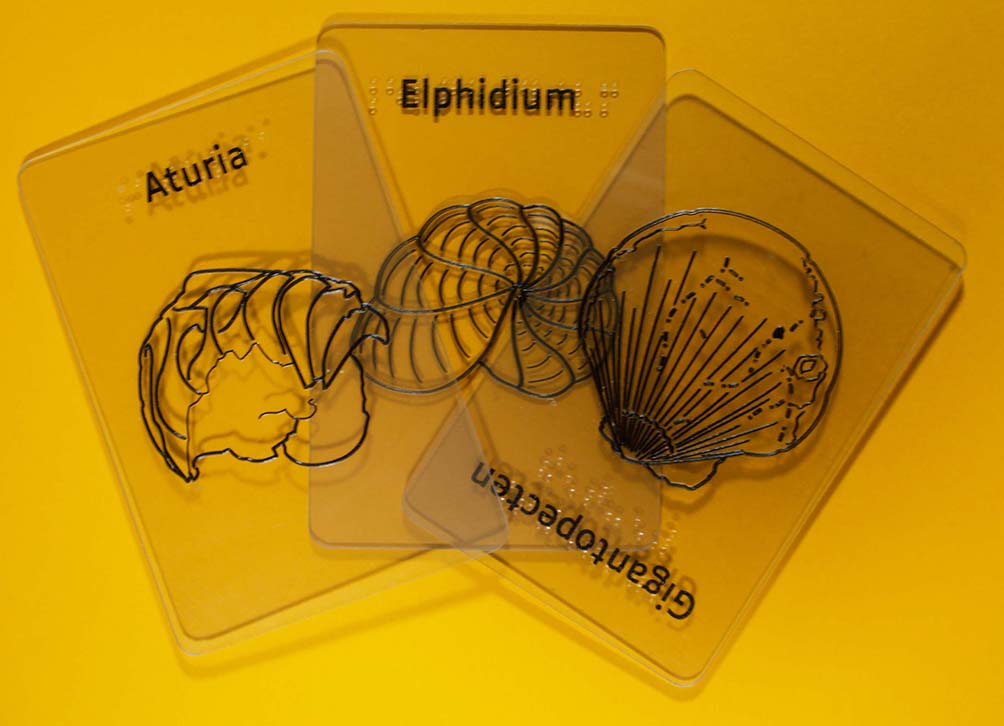
> Tactile playing cards
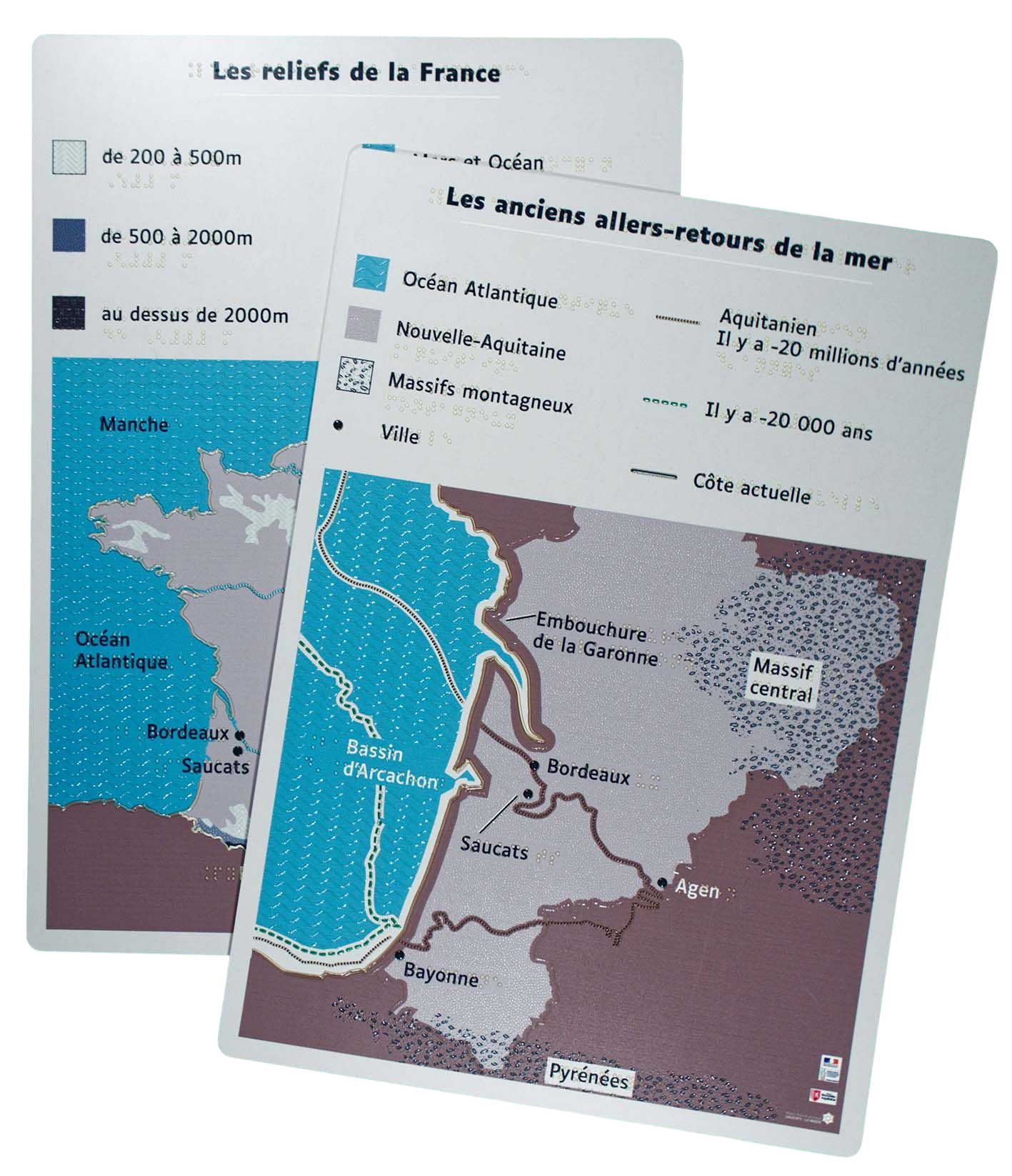
> Geographical maps
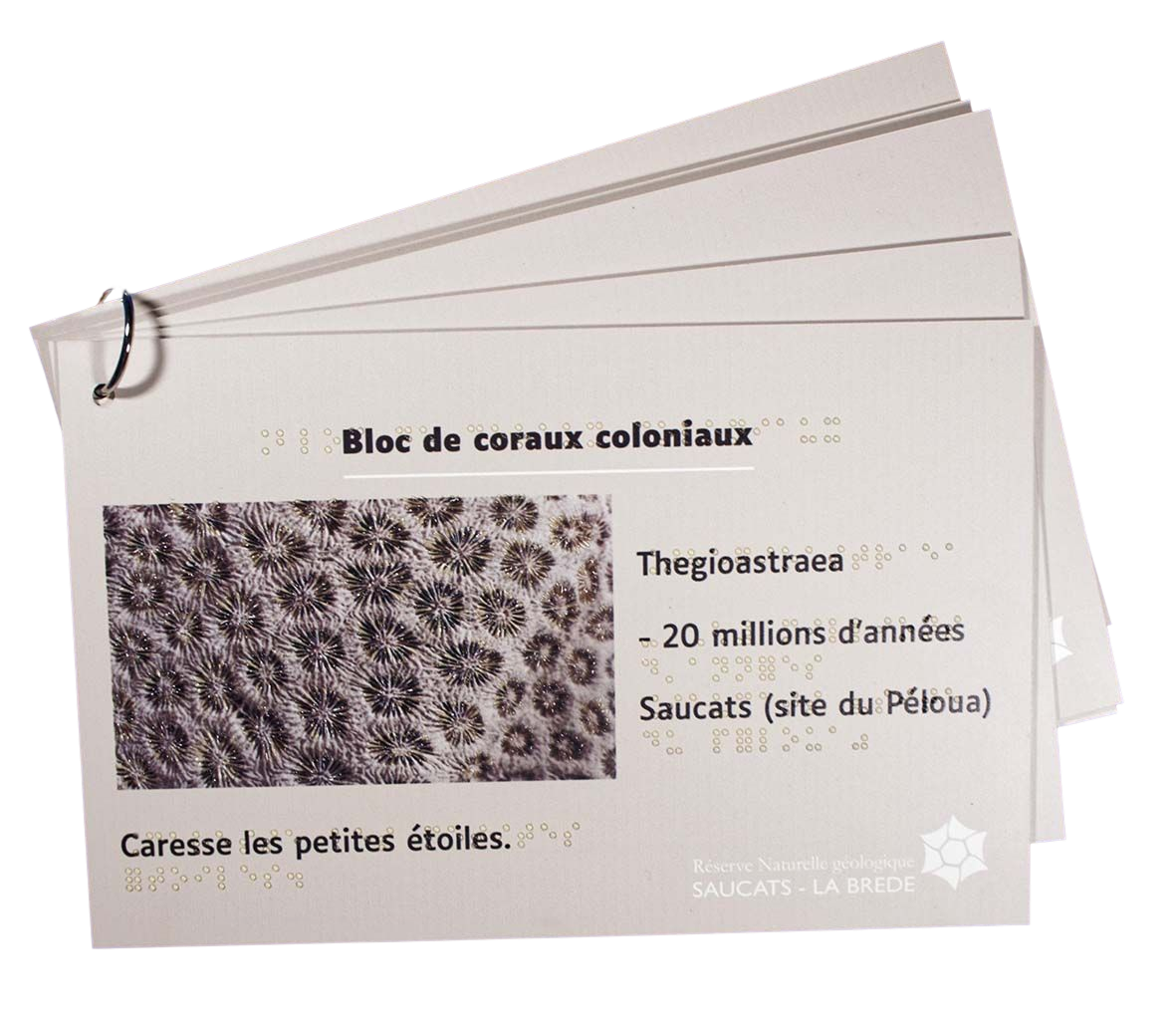
> Illustrated booklet

> Game cards
DÉTAIL DU PROJET
Locating a landscape millions of years old
We began by creating two map boards to establish the geological context. One focuses on the French landscape, while the other illustrates the evolution of the sea in the Aquitaine Basin. Our multi-level relief work, combined with distinct patterns, structures the information and differentiates between land, sea, and topographical variations. These tools serve as valuable aids for locating the site within France's major landforms and for visualizing complex phenomena like coastal retreat.
These boards feature a dual-writing system that overlays Braille with printed characters, the latter being enlarged for visually impaired users. The colors were also reworked to ensure optimal contrast for those with low vision. Thanks to transparent printing, both Braille and black text coexist on a single surface shared by all visitors. The system is equally well-suited for independent exploration or for guided discussions.
Understanding fossils through touch.
In addition to the maps, an educational booklet helps visitors transition from a global view of the region to the details of the objects on display. Since the original fossils cannot be touched, this resource is essential for allowing visitors to grasp the shapes, textures, and characteristics of each specimen. Each page is dedicated to a specific fossil, pairing its scientific context with a multi-level relief interpretation. To guide exploration, short instructions highlight key details of each fossil, making tactile reading immediate and intuitive.
Our design process involved selecting and prioritizing information suitable for touch. Line thickness, relief height, and textures were precisely adjusted to strike the right balance between scientific accuracy and readability.


Turning scientific discovery into a playful experience
The project is rounded out by a set of cards in a discreet, playful format. These cards serve a dual purpose: in the exhibition, they act as labels along the display cases; during guided tours, they transform into a scavenger hunt, inviting children to search for and identify the corresponding fossils. This dynamic tool engages the public while remaining strictly tied to the scientific content.
Printed on transparent PVC, these cards are designed to withstand frequent handling. The designs are simplified: main lines define the overall silhouette, while finer details enrich the tactile experience. This playful approach allows everyone to explore the shapes at their own pace, whether independently or with a mediator.
Designing a coherent and varied tactile trail.
Whether creating dual-script geological boards, 2.5D relief fossil reproductions, or a set of tactile game cards, every element of this project required specific graphic interpretation. Prioritizing information, finding the right level of simplification, and designing a tactile trail that remains consistent across different media requires a demanding balance between scientific accuracy, readability, and integrating accessibility from the very start of the visitor experience. It is through this ongoing research that our expertise is expressed, enabling the Saucats Geological Reserve to open its scientific content to visually impaired visitors.