The Chimera Totem
Two authors take on the challenge of a tactile manga
This initiative is part of the publishing project of the association L'Image au Bout des Doigts (LIBD), which develops a collection of comics and graphic novels designed to support the learning of tactile reading for visually impaired youth.
Each title corresponds to a specific age and reading level: a first comic for children beginning braille (first grade level), followed by a series of graphic stories adapted for elementary, middle, and high school students, featuring stories that resonate with them.
Tactile proficiency is thus refined progressively, both throughout the collection and within each individual work
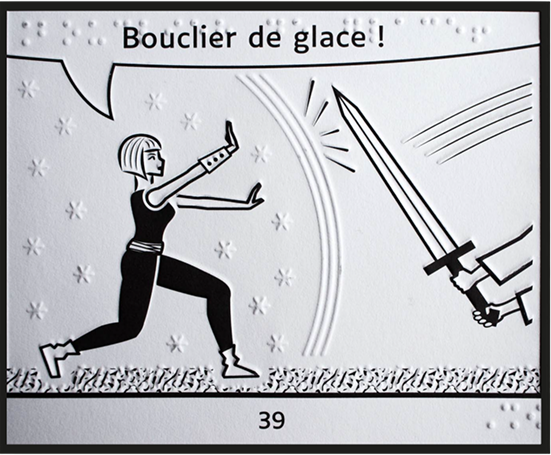
In this context, The Totem of Chimeras is a world first: a bi-graphic manga designed for visually impaired and blind readers. It allows for both visual and tactile reading and has been conceived to be read independently by readers with visual impairments.

> Cover

> Number of pages, wire-o binding, 00 copies

DÉTAIL DU PROJET
Two authors take on the challenge of a tactile manga
The project brings together the illustration and writing talents of the duo Alexandre Ilic and Nicolas Musique, both comic book authors, including the two volumes of Sombre Sel. Alexandre Ilic is also a graphic designer at the National Institute for Blind Youth (INJA) and an author of graphic narratives aimed at visually impaired and blind readers.
The work, published by the LIBD association, received the support of Anne Goscinny.
This graphic book adopts the conventions of manga in their most faithful form: reading from right to left, sequential narration, and artwork inspired by Japanese graphic styles.
But this is not a simple adaptation. The project is based on a deeper intention: to make tactile semiology a language in its own right, serving the narrative.
Designing a tactile manga
From the very first stages of the project, we supported the authors to make this editorial ambition possible, by creating a dialogue between the narrative intent and the constraints of design and production.
Our involvement focused on the technical choices for the book, the braille transcription, as well as the printing, embossing, and binding carried out in our graphic studio.
Our role was to transform an intention—making touch a true storytelling medium—into a book that is editable, tactile, and readable, while remaining faithful to the graphic and narrative vision of both authors.

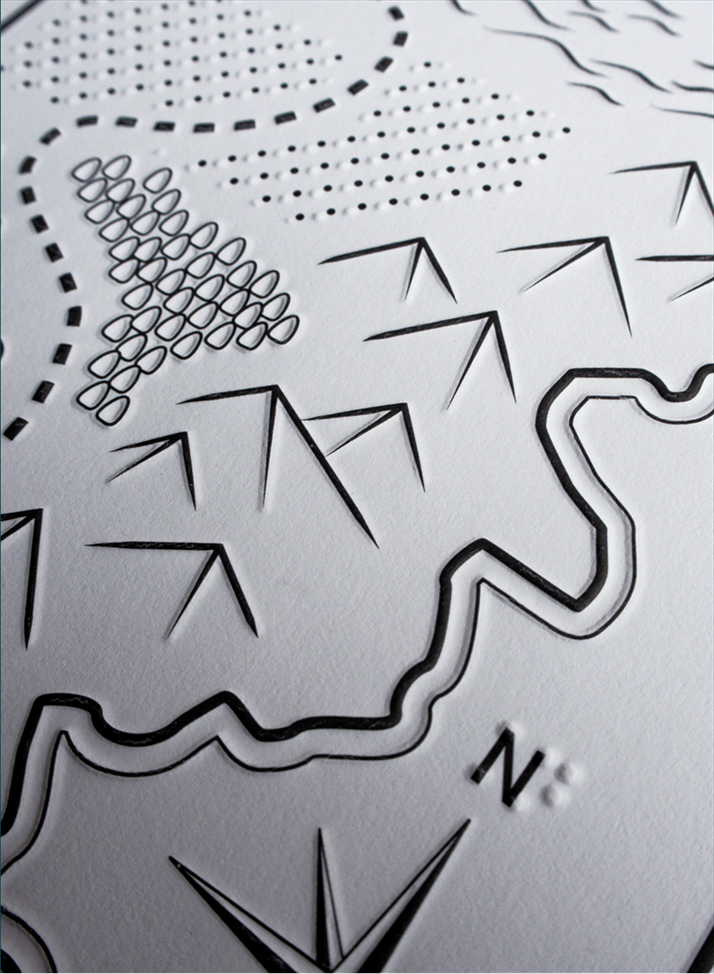

Tactile storytelling at its core
Tactile reading ceases to be a mere adaptation or educational tool and becomes a fundamental element of the work, central to its narrative intent.
Realizing this vision required exceptionally demanding design and manufacturing choices.
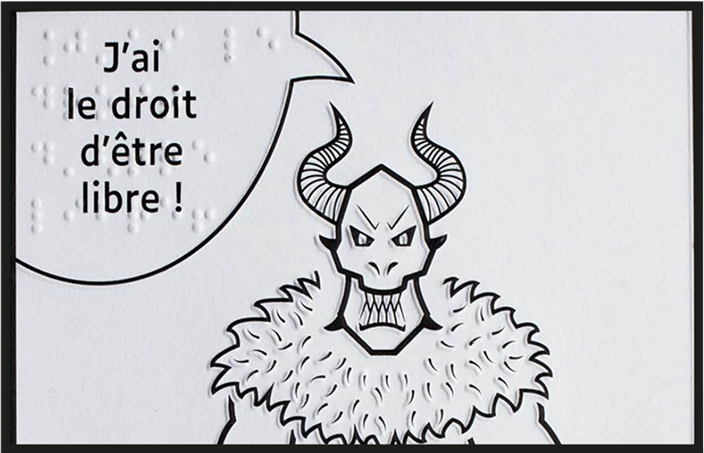
Every page was designed for dual readability. The artwork is rendered in black lines to ensure sufficient contrast for visually impaired readers, and in tactile embossing to allow for finger-reading by blind readers.
The text in the speech bubbles is presented in a dual format: enlarged print with braille overlaid.
Extraordinary manufacturing
As with all ambitious tactile books, a major challenge lies in the embossing. While it creates a positive relief on the front, it also leaves a negative impression on the back, making standard double-sided printing impossible.
However, we wanted the embossing to work on both sides while respecting the Japanese manga reading direction, from right to left.
We therefore designed a system of double pages bound with a Wire-O metal spiral. The pages are printed on one side, folded, and then joined at their free edges.
This setup allows for perfectly flat reading, leaving both hands free to explore the images while hiding the debossed side of the embossing.
It ensures both the tactile readability of the book and adherence to manga reading conventions.